
How many fence strips do I need - calculator and buying guide
How to calculate the number of fence strip sets you need? Simple formula, sample calculations, and tips on additional elements.
Planning to buy fence strips and wondering how many sets you'll need? It's simpler than you think. In this guide, we explain how to calculate the number of sets, how to choose the right size, and what to watch out for so you don't buy too few - or too many.
Basic rule: 1 panel = 1 set
A standard fence panel is 2.5 meters (250 cm) wide. Each panel requires exactly one complete fence strip set. The set contains all the elements needed to fill one panel span: vertical strips, horizontal blocking strips, aluminium mounting pegs, and a top covering strip.
Tip: If your fence has non-standard panel widths (e.g., 2 m or 3 m), contact us - we'll help you determine the right quantity.
Step 1: Count your fence panels
Go outside and count how many panels (spans) your fence has. Count only the panels - don't include posts, gates, or driveways. If the fence runs around the entire property, count panels on each side and add them up.
- Simple method - measure the total fence length in meters and divide by 2.5. Round up the result.
- Example - a 40-meter fence: 40 / 2.5 = 16 panels = 16 sets.
Step 2: Determine your panel height
We offer sets in three standard panel heights:
- 123 cm - the shortest panels, popular as decorative fences or with low walls. Set includes 2 horizontal strips.
- 153 cm - the most popular height. Provides good privacy and is the standard on most housing estates. Set includes 3 horizontal strips.
- 173 cm - the tallest panels, offering full privacy. Ideal when you want complete coverage. Set includes 3 horizontal strips.
Tip: Measure panel height from the bottom to the top edge of the mesh, not counting the foundation wall or protruding posts. The easiest way is to measure directly on the panel with a tape measure.
Step 3: Measure the mesh opening width
We offer two strip variants, designed for different panel types:
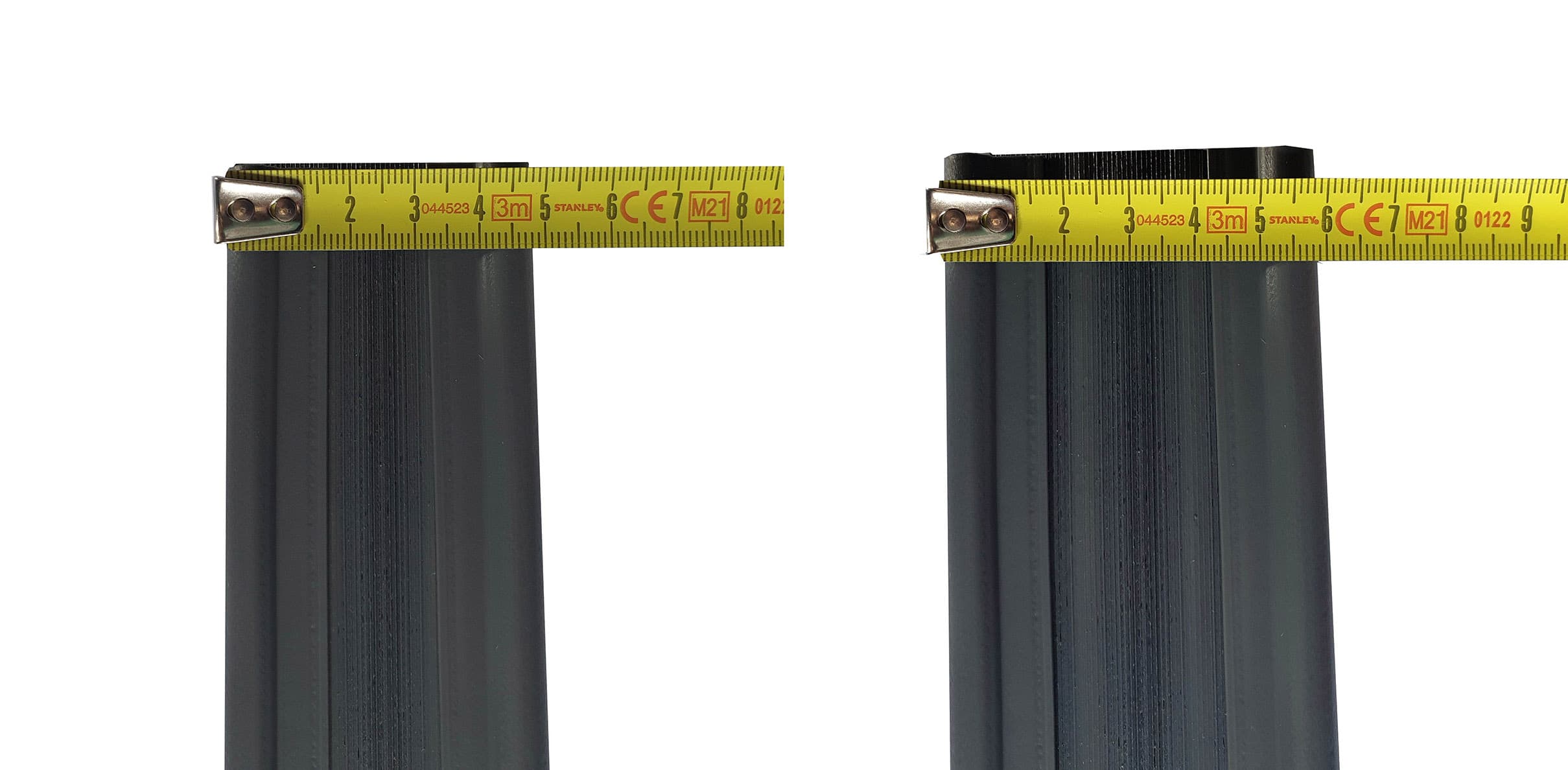
- Narrow mesh (4.4 - 6.2 cm) - set contains 50 narrow vertical strips. Used with denser mesh panels.
- Wide mesh (6.2 - 8 cm) - set contains 39 wide vertical strips. Used with wider mesh panels.
To measure mesh width, hold a ruler horizontally between two vertical wires on the panel. Measure the distance between the inner edges of the wires.
Important: Most standard fence panels have openings of 4.4-6.2 cm (44-62 mm), so the narrow version usually fits. If the result is close to 6.2 cm, measure several openings in different places on the panel.
Calculation formula
Number of panels x 1 = number of sets
(each 2.5 m panel requires one complete set)
10 panels
= 10 sets (25 m of fencing)
20 panels
= 20 sets (50 m of fencing)
30 panels
= 30 sets (75 m of fencing)
Don't forget the extras
Besides standard panel sets, consider these additional elements:
- Post masking strips - cover the vertical posts between panels. Without them, posts remain visible, breaking the uniform appearance of the fence.
- Extra strips for gates - if your pedestrian or driveway gate has panel infill, you'll need separate sets matched to their width.
- Spare sets for potential damage - for larger fences (over 20 panels), it's worth ordering 1-2 extra sets in case a strip gets damaged during installation.
Sample calculations
- 20 x 30 m plot - perimeter: 100 m, panels: 100 / 2.5 = 40. You need 40 sets (minus panels at gates).
- 15 m front fence - panels: 15 / 2.5 = 6. You need 6 sets.
- Corner plot, two sides of 25 m - total 50 m, panels: 50 / 2.5 = 20. You need 20 sets.
Tip: When calculating, subtract the width of the pedestrian gate (typically 1 m) and driveway gate (typically 4-5 m) from the total fence length, unless they also have panel infill.
Frequently asked questions
- Can I trim the strips? - yes, PE strips can be easily cut with scissors if the panel is shorter than the standard 2.5 m.
- Do the strips fit every panel? - our strips fit standard 3D fence panels (with embossments). Before buying, measure the height and mesh width.
- What if I order too many? - unused, unopened sets can be returned within 14 days of delivery.
Summary
Calculating how many fence strip sets you need is straightforward: count your panels, choose the right height and mesh width, then order as many sets as you have panels. Remember extras for posts and consider a small reserve. If in doubt, contact us - we'll help you determine the right quantity.