
Fence strips and privacy - a complete guide
Straight or interlaced mounting? Comparing two fence strip installation methods in terms of privacy, wind resistance, and noise reduction.
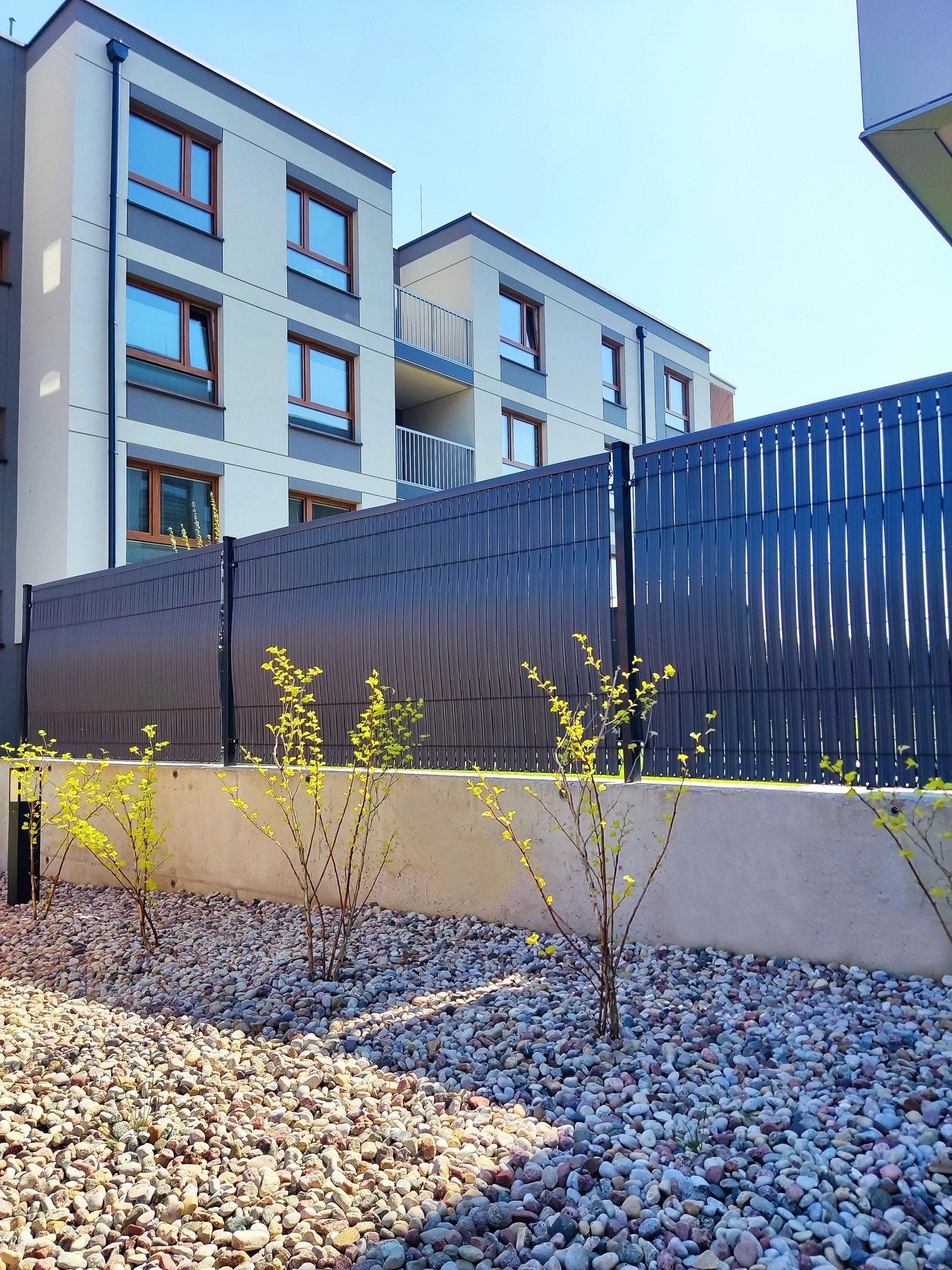
Privacy on your own property is one of the most important needs for homeowners. 3D panel fences, while popular and durable, provide none at all - neighbours can see everything. Fence strips solve this problem, but the level of privacy depends on the installation method. In this guide, we explain the differences between interlaced and straight mounting, discuss noise reduction, wind, and visibility from different angles.
Two mounting methods - two privacy levels
The fence strip manufacturer provides two installation methods that produce significantly different results. Your choice of method affects the level of privacy, airflow, and overall appearance of the fence.
- Straight mounting (all from one side) - strips are inserted into the panel from the same side, creating a uniform, solid surface.
- Interlaced mounting (alternating front-back) - every other strip is inserted from the opposite side of the panel, creating a woven effect.
Straight mounting - maximum privacy
With straight mounting, all strips sit on one side of the panel. The result? A practically solid wall with no gaps. This is the best choice when full privacy is the priority.
- Privacy - close to 100%. Visibility through the fence is minimal.
- Appearance - a uniform, smooth surface on one side. The panel structure with strips is visible from the other side.
- Wind - greater wind resistance, as the surface is nearly solid.
- Stability - slightly lower than interlaced, as strips do not lock against each other.
Tip: Straight mounting is ideal on the street side or facing neighbours, where maximum screening matters. Remember to secure well with mounting pegs, as the solid surface catches more wind.
Interlaced mounting - natural look and ventilation
With interlaced mounting, every other strip is inserted from the opposite side of the panel. They create a characteristic woven pattern that looks identical from both sides of the fence.
- Privacy - approx. 85-90%. When viewed head-on, visibility is minimal, but at sharp angles small gaps may be noticeable.
- Appearance - more decorative, resembling a traditional woven fence. Looks the same from both sides.
- Wind - better air permeability, lower wind load.
- Stability - higher, as strips lock against each other on the panel wires.
Tip: Interlaced mounting is the better choice for areas exposed to strong winds (open fields, hilltops, coastal properties). The gaps allow wind to partially pass through, reducing pressure on the panel.
Privacy from different angles
The level of privacy depends not only on the mounting method but also on the viewing angle. Here is how it works in practice:
- Head-on (90 degrees) - both methods provide excellent privacy. A neighbour standing opposite the fence can see practically nothing.
- Diagonal (45 degrees) - straight mounting still provides full screening. Interlaced may have minimal gaps.
- Sharp angle (below 30 degrees) - interlaced mounting shows narrow slits. Straight mounting still screens effectively.
- From above (e.g., upper-floor window) - both methods provide privacy, as strips are vertical and create a barrier from top to bottom.
In practice, even with interlaced mounting, the gaps are narrow enough that you cannot observe your neighbours through them. At most, you can see movement and outlines, but not details.
Noise reduction
Fence strips are not acoustic insulation, but they do provide noticeable sound dampening. The effect comes from several factors:
- Physical barrier - a solid or nearly solid surface reflects some sound waves.
- Wind dampening - less wind noise passing through the fence.
- Psychological effect - when you cannot see the noise source, it subjectively seems quieter.
Straight mounting provides better noise reduction than interlaced, as it creates a more solid barrier. However, this does not replace professional acoustic screens - the reduction is roughly 3-5 dB, which corresponds to about 25-35% perceived volume decrease.
Tip: If you live near a busy road and noise is the main issue, consider straight mounting combined with a dense hedge. The combination of strips and greenery provides significantly better dampening than strips alone.
Wind - the key factor to consider
Wind is the most important factor when choosing a mounting method. A panel fence with strips changes its aerodynamic properties - from a nearly transparent mesh, it becomes a wind barrier.
- Straight mounting - high wind resistance. During strong gusts, pressure on the panel and posts is significant. Solid post foundations are essential.
- Interlaced mounting - lower wind resistance. Gaps allow some air through, reducing pressure. The better option for windy locations.
Remember that panel fences were designed as open structures. Adding strips significantly increases the wind-facing surface area. Ensure that posts are properly concreted and in good condition.
Which method is better - comparison
Straight mounting
- Privacy: close to 100%
- Appearance: solid wall
- Wind resistance: high
- Strip stability: standard
- Noise reduction: better
- Best for: street side, neighbours
Interlaced mounting
- Privacy: 85-90%
- Appearance: woven, decorative
- Wind resistance: moderate
- Strip stability: higher
- Noise reduction: moderate
- Best for: windy areas, gardens
Combining methods on one fence
There is nothing stopping you from using different mounting methods on different spans of the same fence. This smart approach lets you tailor privacy levels to your needs:
- Street side - straight mounting for maximum privacy.
- Neighbour side - straight or interlaced, depending on the relationship.
- Garden/forest side - interlaced mounting for a natural look and better ventilation.
- Wind-exposed side - interlaced mounting for lower resistance.
Do strips provide privacy in winter?
Yes - and this is one of their biggest advantages over hedges. Polyethylene fence strips look and perform identically throughout the year. They do not lose leaves, dry out, or change colour seasonally.
A deciduous hedge (e.g., privet, hornbeam) loses its leaves in winter and provides no privacy for 4-5 months of the year. Evergreen hedges (thuja, ivy) solve this but need years to grow. Strips deliver instant results all year round.
Summary
Fence strips are an effective solution to the lack of privacy on properties with panel fencing. Straight mounting delivers close to 100% privacy but increases wind resistance. Interlaced mounting is a compromise - 85-90% privacy with better ventilation and stability. You can also combine both methods on one fence, adapting them to specific sides of your property. Regardless of the method chosen, the effect is immediate and lasts all year - no maintenance, no trimming, no replacement needed.